|
DAY 2
 Saturday
at 7:30 am we started our tour after a prayer and
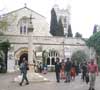
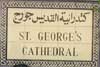
proceeded to St. George Cathedral in Jerusalem where Achen conducted a Holy
Communion Service. We were blessed to be able to receive the Holy Sacraments
at the Lords Table. A Holy Qurbana in the Holy Land! Saturday
at 7:30 am we started our tour after a prayer and
proceeded to St. George Cathedral in Jerusalem where Achen conducted a Holy
Communion Service. We were blessed to be able to receive the Holy Sacraments
at the Lords Table. A Holy Qurbana in the Holy Land!
[Slide show - Cathedral]
We then proceeded to Bethlehem, which is now under Palestine control.
We saw tall concrete
walls made by Israelis to
 separate
Palestine from their land. We passed by a Palestinian refuge camp on the way
to the
Bethlehem town, 8 kms
south of Jerusalem on a hill 800 meters above sea level.
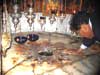
This is where Jesus was born to the Virgin Mary.
The Church
there is called “Church
of Nativity” which is built on the manger (more accurately a grotto or small
cave/opening on the hillside). This is a big church and we are allowed to
visit the place where Jesus born by going through an entrance under the
Altar. We spent almost one hour viewing the various sacred areas of the
church and its paintings and decorations. The Church itself is managed by
the
Arab separate
Palestine from their land. We passed by a Palestinian refuge camp on the way
to the
Bethlehem town, 8 kms
south of Jerusalem on a hill 800 meters above sea level.
This is where Jesus was born to the Virgin Mary.
The Church
there is called “Church
of Nativity” which is built on the manger (more accurately a grotto or small
cave/opening on the hillside). This is a big church and we are allowed to
visit the place where Jesus born by going through an entrance under the
Altar. We spent almost one hour viewing the various sacred areas of the
church and its paintings and decorations. The Church itself is managed by
the
Arab
 and
Armenian
Orthodox Churches. Bethlehem was where
Rachel died and was
buried close to Ephrata and
Armenian
Orthodox Churches. Bethlehem was where
Rachel died and was
buried close to Ephrata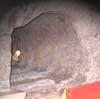 .
(Genesis 35:16-18).
Here Ruth met Boaz and married him. David was anointed to be king in
Bethlehem. Hence the name: “The city of David”. Mary and Joseph came here for
the census from Nazareth of Galilee. While they were here, Mary gave birth
to Jesus (Luke 2:1-20). In 325AD Helena, Constantine’s mother visited the
holy land and built three basilicas -- The first one in Calvary, second in
Bethlehem, third on the top of the Mount of Olives. The tombs of innocent infants
who were killed by the royal decree of King Herod can also be seen here. .
(Genesis 35:16-18).
Here Ruth met Boaz and married him. David was anointed to be king in
Bethlehem. Hence the name: “The city of David”. Mary and Joseph came here for
the census from Nazareth of Galilee. While they were here, Mary gave birth
to Jesus (Luke 2:1-20). In 325AD Helena, Constantine’s mother visited the
holy land and built three basilicas -- The first one in Calvary, second in
Bethlehem, third on the top of the Mount of Olives. The tombs of innocent infants
who were killed by the royal decree of King Herod can also be seen here.
[Slide
show - Bethlehem]
 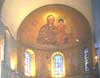 From
Bethlehem,
we
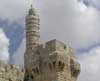
proceeded to Jerusalem, to visit Mount Zion and the
Dormition Abbey
(built by Benedictine
fathers in
1910) where Jesus’ mother, Virgin Mary died. On
the way to Mount Zion, we saw a convent where the nuns are known to never go
outside their compound. We were able to visit the Upper Room where Jesus had
his last supper with his From
Bethlehem,
we
proceeded to Jerusalem, to visit Mount Zion and the
Dormition Abbey
(built by Benedictine
fathers in
1910) where Jesus’ mother, Virgin Mary died. On
the way to Mount Zion, we saw a convent where the nuns are known to never go
outside their compound. We were able to visit the Upper Room where Jesus had
his last supper with his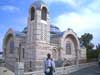 disciples. It is the place where the disciples
were filled with the Holy Spirit, on the
day of Pentecost.
The Tomb of David is also seen nearby and we
visited the site. Our
next stop was St. Peters Church in Gallicantu built by Assumption Fathers in
1931. This is the place St.Peter denied Jesus three times before the crowing
of the cock in fulfillment of Christ’s word.
disciples. It is the place where the disciples
were filled with the Holy Spirit, on the
day of Pentecost.
The Tomb of David is also seen nearby and we
visited the site. Our
next stop was St. Peters Church in Gallicantu built by Assumption Fathers in
1931. This is the place St.Peter denied Jesus three times before the crowing
of the cock in fulfillment of Christ’s word.
[Slide show - Dormition Abbey, Upper Room,
St. Peters church in Gallicantu]
   Later
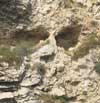
that afternoon, we visited the Garden Tomb. This site, -- north of the
Damascus gate-- is believed by many (especially protestant groups) to be
the place of crucifixion and burial of Jesus Christ. In 1883 the British
general Charles Gordon noted the rocky hill, which resembled a human skull
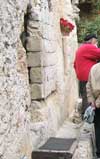
and suggested that this is true Calvary. During excavations, an ancient
garden was found to the west of the hill. In this garden, there is a tomb
which was once sealed with a stone that could be rolled away. In 1892 a
British group purchased the tomb and its surrounding areas and has cared for it
since then by a resident warden. It is commonly known as Gordon’s Calvary.
The place leaves a remarkable impact on the visitor. We can feel the
enormity of the sacrifice and the love of a Savior who laid down his life
for us. Later
that afternoon, we visited the Garden Tomb. This site, -- north of the
Damascus gate-- is believed by many (especially protestant groups) to be
the place of crucifixion and burial of Jesus Christ. In 1883 the British
general Charles Gordon noted the rocky hill, which resembled a human skull
and suggested that this is true Calvary. During excavations, an ancient
garden was found to the west of the hill. In this garden, there is a tomb
which was once sealed with a stone that could be rolled away. In 1892 a
British group purchased the tomb and its surrounding areas and has cared for it
since then by a resident warden. It is commonly known as Gordon’s Calvary.
The place leaves a remarkable impact on the visitor. We can feel the
enormity of the sacrifice and the love of a Savior who laid down his life
for us.
[Slide show -
Place of skull (Thalayodidam), Garden Tomb]
Later we drove past the Bank of Israel and the Knesset (Israel’s parliament
building). The Knesset is composed of 120 members elected by a general vote
of all the citizens over the age of 18. Nearby is the Shrine of the Book
(Dead Sea Scrolls). It is a small museum in an onion shaped building. It is
designed to resemble the lid of the jars in which the Dead Sea scrolls where
found. Later we drove down Prophet Street and saw the Hebrew university before we
returned to our hotel. |
