|
DAY 1
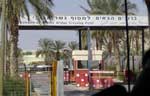 After
a pleasant journey and an evening in Amman, Jordan, we started on the tour
early on Friday morning. We chose to enter the Holy Land using the route
used by the Israelites when they were led by Moses (from Egypt) and then Joshua
into the Promised Land. Our crossing was by road across the Allenby bridge
from Jordan to reach Jericho, called the 'city of palms' in the ancient times. After
a pleasant journey and an evening in Amman, Jordan, we started on the tour
early on Friday morning. We chose to enter the Holy Land using the route
used by the Israelites when they were led by Moses (from Egypt) and then Joshua
into the Promised Land. Our crossing was by road across the Allenby bridge
from Jordan to reach Jericho, called the 'city of palms' in the ancient times.
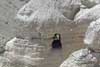 We
took the opportunity to first pass by the Qumran Caves in the foothills of
the Judean wilderness.
This site is now famous for the Dead Sea Scrolls which were accidentally
discovered by a Bedouin boy in 1947, who was We
took the opportunity to first pass by the Qumran Caves in the foothills of
the Judean wilderness.
This site is now famous for the Dead Sea Scrolls which were accidentally
discovered by a Bedouin boy in 1947, who was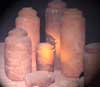 looking for his stray goat.
While out searching for it in a deep valley, he threw a stone into a cave
and heard what sounded like the breaking of pottery. The rest is now
history. They found some pottery jars 60 to 75 cms high
and about 25 cms wide. In them they found the leather scrolls of ancient
Hebrew, Aramaic and Greek manuscripts. These are now exhibited in the Shrine
of the Book at the Israel museum. The authors of the scrolls were the
“Essenes” or “people of the scrolls”—people who left the evils and wrongs in
cities of their time to “go into the desert to prepare the way for the LORD
and make straight in the wilderness a highway for the LORD. They were a
religious sect which led a life of prayer, study, meditation, poverty and
charity. looking for his stray goat.
While out searching for it in a deep valley, he threw a stone into a cave
and heard what sounded like the breaking of pottery. The rest is now
history. They found some pottery jars 60 to 75 cms high
and about 25 cms wide. In them they found the leather scrolls of ancient
Hebrew, Aramaic and Greek manuscripts. These are now exhibited in the Shrine
of the Book at the Israel museum. The authors of the scrolls were the
“Essenes” or “people of the scrolls”—people who left the evils and wrongs in
cities of their time to “go into the desert to prepare the way for the LORD
and make straight in the wilderness a highway for the LORD. They were a
religious sect which led a life of prayer, study, meditation, poverty and
charity.
The
first city we visited after Qumran was the city of Jericho. Incidentally,
Jericho was the first city taken by the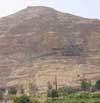 tribes tribes
 of Israel after they
crossed River Jordan. This is the lowest inhabited city on earth, located in
the region of the Dead Sea, (290 meters below sea level). There are 5
springs around Jericho. More than twenty different types of fruits
and other produce are grown here. Date palms stand alongside orange groves
and banana plantations. During his earthly ministry, Jesus must have also
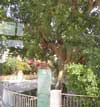
stopped over at Jericho many times. It was here that Zaccheas the publican
climbed a sycamore tree so that he could see Jesus (Luke 19:1-10). It is
believed that this was where our LORD faced his temptation. (In the Judean
wilderness) We had our lunch from a hotel called the Temptation Restaurant
in the city of Jericho. We drove to the foot hill to have a closer view of
the Monastery atop Mount Temptation. of Israel after they
crossed River Jordan. This is the lowest inhabited city on earth, located in
the region of the Dead Sea, (290 meters below sea level). There are 5
springs around Jericho. More than twenty different types of fruits
and other produce are grown here. Date palms stand alongside orange groves
and banana plantations. During his earthly ministry, Jesus must have also
stopped over at Jericho many times. It was here that Zaccheas the publican
climbed a sycamore tree so that he could see Jesus (Luke 19:1-10). It is
believed that this was where our LORD faced his temptation. (In the Judean
wilderness) We had our lunch from a hotel called the Temptation Restaurant
in the city of Jericho. We drove to the foot hill to have a closer view of
the Monastery atop Mount Temptation.
[Slide show
- Qumran, Jericho and Mount Temptation]
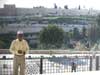 Then we left for Jerusalem and while traveling we saw many caves where monks
used to pray in t Then we left for Jerusalem and while traveling we saw many caves where monks
used to pray in t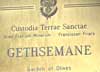 he ancient times. Jerusalem is a city 850 meters above sea
level. The distance between Jericho and Jerusalem is 28 Kms. The story of
the Good Samaritan narrated by Jesus happened in this route, as one had to
go through Jericho to get to Samaria. The Kidron valley separates Jerusalem
from the Mount of Olives. Jesus possibly used this route to he ancient times. Jerusalem is a city 850 meters above sea
level. The distance between Jericho and Jerusalem is 28 Kms. The story of
the Good Samaritan narrated by Jesus happened in this route, as one had to
go through Jericho to get to Samaria. The Kidron valley separates Jerusalem
from the Mount of Olives. Jesus possibly used this route to
 go from the temple
through the Golden Gate to the Garden of Gethsemane at the foot of the Mount
of Olives. The Mount of Olives is located to the east of Jerusalem, 100
meters higher than Jerusalem. The Old Testament prophets Zechariah and Malachi were buried here and as Christians we go from the temple
through the Golden Gate to the Garden of Gethsemane at the foot of the Mount
of Olives. The Mount of Olives is located to the east of Jerusalem, 100
meters higher than Jerusalem. The Old Testament prophets Zechariah and Malachi were buried here and as Christians we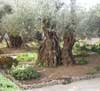 believe that it is the place of
the Accession of Jesus. Jesus Christ frequently visited this place for
meditation and prayer. Here we can see what is believed to be the foot print
of Jesus believe that it is the place of
the Accession of Jesus. Jesus Christ frequently visited this place for
meditation and prayer. Here we can see what is believed to be the foot print
of Jesus
 imprinted on a piece of rock. It is believed that Jesus ascended to
Heaven from the top of the Mount Olive and the Church of Ascension is situated
here. During the Muslim era, they built a mosque and shut out the church.
Even today, Muslim believers gather to pray in the mosque while the church
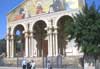
is not in use for worship. At the Garden of Gethsemane we visited the Church
of All Nations and the Mary Magdalene Church (Russian Orthodox). The Church
of All Nations or The Church of Gethsemane was build by 16 nations. Inside
the church there imprinted on a piece of rock. It is believed that Jesus ascended to
Heaven from the top of the Mount Olive and the Church of Ascension is situated
here. During the Muslim era, they built a mosque and shut out the church.
Even today, Muslim believers gather to pray in the mosque while the church
is not in use for worship. At the Garden of Gethsemane we visited the Church
of All Nations and the Mary Magdalene Church (Russian Orthodox). The Church
of All Nations or The Church of Gethsemane was build by 16 nations. Inside
the church there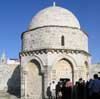 is a rock on which Jesus sat and prayed to The Father and
underwent the most sorrowful hour of his passion after is a rock on which Jesus sat and prayed to The Father and
underwent the most sorrowful hour of his passion after
 the Last Supper. On
the slopes of the Mount Olives is the largest and the oldest Jewish cemetery in
the world. Many Jews are buried here, near the valley of Jehoshaphat where it is
believed that the final resurrection and judgment will take place (Joel
3:2). We also saw El Aksa Mosque (The Distant Mosque) which was built on
the site of Solomon’s palace. Adjacent to this is the Dome of The Rock which
was built on the rock where Abraham prepared to sacrifice his son Isaac. the Last Supper. On
the slopes of the Mount Olives is the largest and the oldest Jewish cemetery in
the world. Many Jews are buried here, near the valley of Jehoshaphat where it is
believed that the final resurrection and judgment will take place (Joel
3:2). We also saw El Aksa Mosque (The Distant Mosque) which was built on
the site of Solomon’s palace. Adjacent to this is the Dome of The Rock which
was built on the rock where Abraham prepared to sacrifice his son Isaac.
[Slide show - Gethsemane, Church of All Nations]
[Slide show - Mount Olive, Ascension Church]
 We
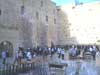
visited the Wailing Wall in Old Jerusalem which is the only remaining
structure from the original Temple built by King Solomon. This place is very
important for Jews and it depicts their suffering at the
hands of foreign invaders. We saw many Jews attending prayers led by their
Rabbis. All men should wear their traditional cap before approaching the
wall while it is customary
for women to remove their head coverings. People sometimes write their
subjects for the prayer in a piece
of paper and insert into the wall before they start praying. We
visited the Wailing Wall in Old Jerusalem which is the only remaining
structure from the original Temple built by King Solomon. This place is very
important for Jews and it depicts their suffering at the
hands of foreign invaders. We saw many Jews attending prayers led by their
Rabbis. All men should wear their traditional cap before approaching the
wall while it is customary
for women to remove their head coverings. People sometimes write their
subjects for the prayer in a piece
of paper and insert into the wall before they start praying.
[Slide show - Old Jerusalem]
On
the way to our Hotel, we saw the Hinnom valley and Akaldhama where Judas
Iscariot hung himself in the potter’s land. We drove past the Siloam pool.
This pool is visible but there is no water in it.
We
spent the night at Jerusalem’s’ Caesar Hotel. |
